
Real Estate Brokers • Operations Leaders • Property Managers • Owner-Operators
The World's First Fully Managed Back Office Built on Systems You Own.
We Document Your Processes Once, Then Our Trained Team Handles Your Busywork Forever.

Admin Advantage is a done-for-you back-office operation, built to document your recurring admin work once, turn every task into an SOP you own, and run it all for you daily with a managed team.
Let us free you and your team to focus on clients and deals (instead of the never-ending admin catch-up that keeps you working below your pay grade).

"I run Strategy Calls every week, and there's a moment that happens in almost all of them. I'll ask the owner to walk me through how something actually gets done in their business, and about halfway through the explanation they stop and say... 'You know what, I'm not sure. She just handles it.' Nobody ever wrote it down. That's the real problem, and it's the first thing we fix. One Over-the-Shoulder call, we document it, and then we run it for you. Everything else about Admin Advantage is built on top of that."
- Ali Murtaza, REVAS CEO
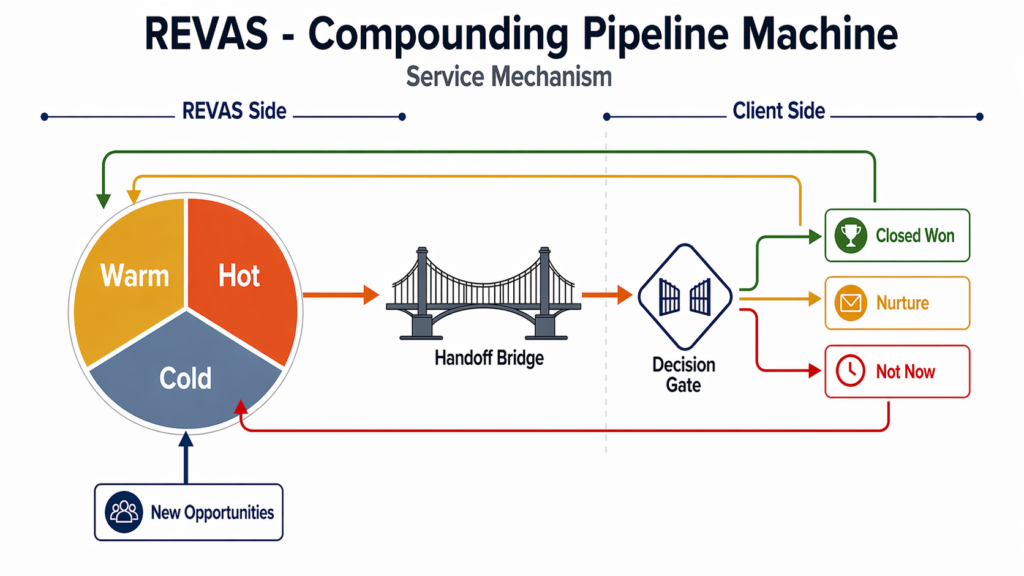
Every Workflow you offload starts the same way: one Over-the-Shoulder Training Call.
You walk us through the task once, start to finish. Except this is the last time you will ever explain it. We record the call, document every step into an SOP you own, and a trained team runs it from then on. Daily, weekly, monthly, permanently.
That’s one push of the wheel. So what makes it a Flywheel?
By month six, tasks you and your team used to handle personally every single day become successfully completed line items you hear about in a weekly report.
That’s the Workflow Flywheel: you push once, and it keeps turning without you.
| The Old Way | The REVAS Flywheel Way |
|---|---|
| You train every new hire from scratch. | You explain each task once, ever. |
| The process lives in someone's head. | The process lives in an SOP you own. |
| Quality depends on who's doing the work. | Quality lives in the process, so any trained person can run it. |
| Someone quits, and you start over. | Someone leaves, and we replace and retrain at our cost. Nothing breaks. |
| Growing means more hires and more managing. | Growing means more Workflows on a wheel that's already turning. |
When you look at the table above, comparing the Old Way vs the REVAS Way, you might notice that every failure in the left column happens for the same reason:
The quality of the work, and the method behind it, was always locked inside a person’s head.
The right column (“The REVAS Way”) is what happens when you make one change and move the quality into a process instead of a person.
By running your business off documented procedures instead of relying on what’s inside your team members’ brains, you’re building a more resilient, scalable, valuable system.
That concept, of building a Process-Based, Not People-Based business is bigger than Admin Advantage; it’s one of the key operating principles behind everything REVAS builds.
Every Workflow you’ll ever offload is built from one Over-the-Shoulder Training Call. You, or whoever knows the task best, runs it live from your own desktop on a screen share. Show it the way you’d show a new hire, once, and you’re done teaching forever.
On our side of the screen, we record the full session and document the task as you run it, one step at a time. Then your Manager runs the task themselves, end to end, and finds any missing pieces (like forgotten authentication steps, unclear guidance, or open questions) before your team ever touches it. Only then does it get finalized into the step-by-step SOP: the document that becomes the permanent foundation of the Workflow, the thing your trained team runs from, and the asset you own.
You don’t write any documentation or build a training manual, and you can forget about blocking out that “finally systematize the business” week that never comes. You do the task one more time, on camera, and that’s it.
Already know what you’d hand off? If you’re already using VAs and know exactly which tasks you’d delegate, you can skip the sales conversation entirely: start with Self-Checkout, and your first working step is the same Training Call. Checkout itself takes minutes: pick your tier, answer a short questionnaire about your operation, and schedule your first Training Call before you’re done. You’ll hear from us right after checkout, and that first call is run by your Ops Manager. If you’re not sure (most people aren’t), book the Strategy Session and Ali will tell you honestly whether this fits. Both doors lead to the same first step, and neither one has an intake form in front of it, because “describe your task and upload your documents” captures a fraction of what one recorded Training Call captures.
The first Workflow is a real decision, and we make it with you on the Strategy Session. The selection rule is simple: the task sitting furthest below your pay grade goes first. The one where the gap between what your hour is worth and what the task is worth is widest.
And when that’s a coin flip, opportunity cost breaks the tie: the most dreaded item on the recurring list, the one that eats the most time. Frustration is opportunity cost in another form.
That’s why the Strategy Session is worth having before you move forward on anything else.
Your first Training Call happens within 1–3 days of starting. A trained team member is running your first Workflow within 10–15 days.
There’s no onboarding quarter and no implementation roadmap. About two weeks after you explain the task once, it’s delegated off your plate forever.
Think about the best admin person you ever had. Not a marketplace VA. Your own salaried, in-house employee, someone you trusted. The one who ran things so smoothly you stopped thinking about how things ran.
Now remember the day they gave notice.
It took about two weeks to find out what you’d actually lost. Not the labor. Labor is replaceable; you had someone new in the seat within a month. What you lost was the way the work got done. Which report went out on which morning. What got double-checked before a file went anywhere near compliance. Which vendor picks up on the first call and which one needs three. None of it was written down anywhere. It lived in their head, and it left in the elevator with them.
So you did what every owner does. You rebuilt it from memory, at night, while training a new hire on a process you only half-knew yourself. And somewhere in those weeks you made a quiet decision: never again. Never let one person get that deep into the business. Keep more of it in your own hands, where it’s safe.
People leave. That part is normal, and no salary or company culture will ever fully stop it. The departure was never the catastrophe.
The catastrophe was that nothing was ever written down.
You didn’t fail at delegating. You delegated the person instead of the process — so the quality lived in their head and left when they did.
That’s the whole diagnosis. Not your judgment. Not the person. Not the hiring market in your area. The missing process. And the lesson you took from it was exactly backwards. Holding everything closer and delegating less didn’t protect you from the next departure. It just guaranteed you’d be the one doing the work in the meantime.
We know because we were the ones doing it wrong. REVAS launched in 2013 as a virtual assistant service for real estate professionals, and for 13+ years across 400+ real estate companies, we watched this exact failure repeat. Talented people hired. Processes never documented. Quality walking out the door with every departure, on their side and ours. Not theorized: watched, in four hundred variations, across 700,000+ work hours. That’s how we know precisely where delegation breaks, and why.
The lesson that survived all of it: nobody wants employees. They want outcomes. So in 2022, we took everything those years had taught us and rebuilt the entire company around one rule.

"A person is not a solution to a problem without a process. That's why everything we do is Process-Based, Not People-Based."
- Marshall Hatfield, REVAS Founder & Advisor
"Here's the part almost nobody in this industry says out loud. Most small companies are unsellable. The revenue is real. The problem is the business is the owner. Every process lives in his head, or in the heads of two or three people who could give notice tomorrow. A buyer looks at that and sees risk instead of an asset; owner-dependency is one of the first red flags in any acquisition review. A business that runs on documented, delegated systems is a different animal. It's transferable, which means it's sellable, which means the owner actually owns something. And even if you never sell (especially if you never sell), the difference matters, because the alternative has a name too. It's called a job you can never leave. I've watched too many owners work that job until it outlasted them."
- Marshall Hatfield, REVAS Founder & Advisor
Delegating the process instead of the person runs the same way for every task you hand off. It has three stages, and only the third one repeats.
Setup. The Over-the-Shoulder Training Call you already know: you show the task once, your Manager test-runs it, the finalized SOP gets built, and your team is trained and tested on it before anything goes live. That’s the push that spins the wheel.
Launch. The Workflow goes live under close watch. In the early weeks, your Ops Manager runs frequent check-ins with you until the output is indistinguishable from what you’d produce yourself. Then the check-ins spread out, because there’s less and less to fix.
Optimize, and repeat. The Workflow keeps running on the energy you already put in. And when the next task is ready to come off your plate, it starts with its own Training Call and joins a wheel that’s already turning.
Clients typically add a new Workflow five to ten times a year. Each one is easier to hand off than the last, because the team running it already works inside your business every day.
The repetition is the mechanism.
The whole engagement runs on a structure you barely have to touch. A dedicated Ops Manager is your single point of contact: one person who knows every Workflow you’ve offloaded, because they ran each one personally before your team was trained on it. Behind them, a managed team executes your SOPs: data entry, MLS updates, transaction coordination, email, scheduling, research, lead follow-up, whatever you offload.
You don’t recruit, train, schedule, or replace anyone. When a team member moves on, we recruit and retrain the replacement at our cost, and because the work lives in the SOP instead of their head, nothing about your operation breaks while it happens.
You manage one relationship, and a full back office runs behind the wall.
Done right, it almost feels like we’re not even there. Your people are simply more productive, doing less low-level work, and the questions that used to route up to you get answered by a document instead.
You don’t need to understand AI or even like it. It works on our side of the screen. When you run a Training Call, AI writes down every step as you show it, like a notetaker that never misses anything. Your Manager then does the task themselves, fixes anything the notes got wrong, and that becomes your SOP. Nothing you showed us gets lost.
AI helps on the other end too. When a task has clear written instructions, AI helps the person doing it get it right, and clear written instructions are exactly what an SOP is. The work itself is always done by people. AI just makes the playbook they follow more powerful.
What you get is specific: the recurring tasks you name, documented into SOPs you own and run daily by a trained team. What that looks like depends on which chair you’re sitting in.
For the broker-owner buried in paperwork you never wanted: the transaction paperwork, and the CRM that finally stays current without a late-night catch-up session.
For the ops leader whose team is drowning in admin: the overflow absorbed without another hire cycle, and quality that stops depending on who’s in the seat.
For the investment-shop principal doing $15-an-hour work at midnight: that exact work, running at $15-an-hour rates, while your hours go to the deals only you can do.
For the PM owner whose growth hit an invisible admin ceiling: work orders logged, tenant messages answered, maintenance coordinated, at a door count your current back office couldn’t carry.
For the solo operator, the win is personal: your hours and your evenings come back.
For the owner running a team, it multiplies: every person on payroll doing less below-pay-grade work is capacity you didn’t have to hire, and every handoff that stops slipping is a deal or a client you don’t quietly lose.
The root is the same at every scale. You stop carrying the undone work.
The logic underneath has a name: the Pay-Grade Principle.
You only earn your rate when you stop doing the work that sits below it.
Every hour spent on a task someone else could run for a tenth of your rate is an hour billed to you at the difference. You know what your hour is worth, and you know how many hours last week went to work that wasn’t worth it. The math is yours to run.
It’s a Tuesday, three weeks after launch. The MLS updates that used to eat your morning, the ones you kept doing yourself because explaining them felt like more work than doing them, just happened. You didn’t touch them. You explained the process once, on a Training Call, weeks ago, and now it runs without you. You find out it’s done because you checked, not because you did it.
That’s the first Workflow off your plate. The relief runs deeper than the time saved: that task is gone for good, along with the attention it used to eat.
That’s one weight on the wheel. The next one goes on easier.
Ready to Find Out Which Task Comes Off Your Plate First?
Thirty minutes with REVAS CEO Ali Murtaza. You’ll leave with your first Workflow picked and a straight answer on fit, even if you never spend a dollar with us.
Four things separate Admin Advantage from the help you’ve hired before, and every one of them is structural: built into how the system works.
Setup costs you one Over-the-Shoulder Training Call per task, not a month of your calendar. You show the task once, we document every step, and a trained team member carries it from there. The documentation work that never got done in your business is our job now, on our hours.
Every Workflow runs from an SOP, so no single person is a point of failure. When someone on our team running your work moves on, the process stays right where it was. We train a replacement at our cost, and your Ops Manager handles the whole transition. The thing that broke your operation last time can’t break it this time.
Every SOP is written from how your business actually runs: on your screen share, in your own tools. Nothing starts from another company’s playbook. If your process has a quirk, the SOP carries the quirk.
Every SOP and training document is yours, permanently, along with all of your data. If you ever leave REVAS, you take all of it with you and hand it to anyone you like. The protection is structural. It doesn’t depend on our goodwill.
All four are easy to say. What follows is the record.
Below are five REVAS clients, by name: the Workflows we ran for them, and how long we ran them.
A 5-star reviewed brokerage in Tallahassee, Florida. They came to REVAS because admin tasks kept pulling their team away from client service.
Social media, MLS updates, blog posting, market research — the same Workflows, documented once, run for roughly a decade.
Ten years of delegated client-facing work, and the 5-star reputation held the whole way.
Most VA relationships don’t survive the first departure. This one survived every staffing change on both sides, because the process never left with a person.
One of New York City’s largest independent brokerages. High-volume operations were drowning their agents in administrative tasks.
MLS updates, listing syndication, and lease coordination across their operation. Years of it, at NYC volume.
Over that time, the arrangement freed up thousands of agent hours for the work agents are actually paid for: clients, showings, deals.
Mike Ferrante leads one of Northeast Ohio’s highest-producing real estate teams: nearly 3,000 transactions since 2008, and a 5.0 rating across 130+ Zillow reviews.
His arrangement with REVAS, running for years: complete administrative delegation. Not one task. The whole load.
A producer at that level doesn’t hand over his entire back office on faith. He does it because the work comes back right, every time, from a process he can inspect.
A property management company operating across New York and Florida. In-house admin costs were eating into margins as they grew.
Lead qualification, maintenance coordination, and tenant services — years of it, replacing multiple high-cost in-house admin roles with a managed team running documented SOPs.
The engagement ran through their growth years, up to the company’s acquisition.
A freight brokerage. Not real estate. No overlap with anything REVAS had run before.
Dispatch, load management, carrier setup, and invoicing — the full back-office operation, documented from a standing start and run by a managed team.
There was no freight template to start from. There didn’t need to be. The owner walked us through each process once, REVAS documented it, and the documentation did the rest.
If a freight brokerage’s dispatch operation can be documented and run this way, your back office can be.
These five clients are the closest look. The full record behind them: 13+ years, 400+ real estate companies, and 700,000+ work hours. More than 20 million emails, listings, transactions, and documents handled along the way.
Every engagement in that record began the same way: an owner walked us through a task once, and we documented it.
Five kinds of buyers should not buy this. We would rather tell you now than have you find out in month one.
Admin Advantage is built for recurring work: the tasks that run the same way every day, week, or month. If the task is a one-off, or it happens differently every time, there is no process to document, and an SOP for work that never repeats is paper nobody will use.
Admin Advantage documents your process and runs it. It does not invent a process you never had. If you’re looking for an outside expert to add something new, a task nobody in the business knows how to do yet, that’s a hire, and it isn’t this. If nobody on your team can walk through the task step by step, there is nothing for us to document.
Every Workflow starts with one Over-the-Shoulder Training Call, and somebody who knows the task has to sit through it: run every step on camera and answer questions that will feel small, like which folder a file saves to or what happens when a number doesn’t match. That detail is what makes the SOP real. It doesn’t have to be you, but it has to be the person who knows the task best, and they have to be committed to that one call. If nobody is ready and willing to do that, don’t start.
Everything we run is remote. If the task needs a person on site, at a property or in your office, we can’t run it. We can often take over the scheduling and follow-up around that work, but the on-site part stays local, and if that part is the whole task, this isn’t the tool.
Some work is legally reserved for licensed professionals, and we don’t touch it, in any state, for any client. If the task itself requires a license rather than just the admin around it, it stays with you.
We decline all five of these on Strategy Sessions, and it costs us sales. The reason is simple. The whole point of Admin Advantage is a back office that runs on a system you own instead of on you. If the system never gets built, or there is nothing to build it from, nobody gets what they came for.
Admin Advantage is priced by the hour, in sizes that run from a quarter of a full-time seat to a full back-office team. You buy the hours. The table shows how many Workflows each size realistically absorbs.
| Tier | Hours/Month | Rate | ~Monthly | Concurrent Workflows |
|---|---|---|---|---|
| Starter | 40 | $12.50/hr | $500 | 1–2 |
| Part-Time | 80 | $10/hr | $800 | 3–5 |
| Full-Time | 160 | $8.75/hr | $1,400 | 5–8 |
| Enterprise | 480+ | Custom | Scoped individually | A full back office |
Starter (40 hours) is a quarter of a seat running one or two Workflows. It exists because the work really does cap there for some operations: an individual broker or owner with about two hours a day of recurring tasks to hand off.
Part-Time (80 hours) is half a seat running three to five Workflows: a couple of hours a day of delegated work, with room to expand as the next task comes off your plate.
Full-Time (160 hours) is a dedicated team member running five to eight Workflows, for the operation whose recurring load runs deep.
Enterprise (480+ hours) is three full-time seats and up: a managed back-office team. The full picture is below.
The rate falls as the hours rise, on purpose. Beyond the tier price, every engagement carries a $500 one-time setup fee and a $29 per month platform fee. The setup fee is paid once, at the start.
Workflows you add later carry no additional setup fee; documenting new work is part of the service. Adding the next Workflow is cheaper than the first, in fees the same as in effort.
And if you want to prove this out before committing further, Starter is the low-stakes way in. Month one at Starter comes to $1,029 all in:
Run one Workflow through it, and whatever you decide afterward, you walk away owning the SOP and the experience. You could hand that SOP to a different VA tomorrow if you wanted to. Most buyers start bigger, but the door exists, and those are the real numbers for walking through it.
Across the client base, 35% run at least one full-time seat, and engagements at three or more full-time seats are nearly as common as half-seat ones. The tiers are an entry ramp more than a destination: most operations climb as the wheel gains weight, one Workflow at a time.
The rates at scale. The honest number depends on which Workflows you’re running, so these are ranges rather than quotes:
The number gets exact on a Strategy Session.
How an engagement grows. The way the Flywheel already turns: Workflow by Workflow. We’ll start by delegating one or two repetitive tasks. Then, once those processes have stabilized, we’ll add two or three more. That might fill the plate of one full-time team member, or it might require a team of ten (depending on the volume of those Workflows).
The in-house comparison. At this scale, the number worth running is against your own org chart. A fully-loaded in-house admin hire runs $53,000+ a year once you count:
Against that sits one managed team that can’t quit on you and scales without a hiring cycle, with no payroll or HR carried on your side. Twenty salaries plus turnover, or one managed team that can’t quit. You know how many seats you’re contemplating. Multiply it out, and put the two numbers side by side.
Every Admin Advantage engagement carries the same three guarantees, from Starter to Enterprise. They come in this order for a reason: each one is what makes the next one worth having.
Every Workflow you delegate ends as a documented system. One Over-the-Shoulder Training Call becomes a finished SOP, and each SOP joins a library that grows one Workflow at a time. Months in, the recurring work you’ve handed off exists in writing, most of it for the first time, and you never sat down to write any of it. Delegating the work is what documents the work.
And once a year, we review every SOP against how the work actually runs and update what’s moved, so the documentation stays current as your tools and your business change.
Everything the first guarantee produces is yours from day one: every SOP and every training video, plus all of your data. If you ever leave, it all exports with you, and you can hand it to an in-house hire or another provider the next morning. The work we documented for your business stays with your business.
Every engagement runs month-to-month. Cancel any time; a day’s notice is all we ask.
Your systems get documented, you own the documentation, and you can leave with it any month you choose. The only thing keeping you here is your continued satisfaction with the work.
Whether this fits your operation gets decided on a Strategy Session.
Every piece of Admin Advantage has been covered somewhere on this page. This is all of it in one place, against the price.
You show the task once, on a screen share, and we record every step. That call is the only setup any Workflow ever asks of you.
Each Training Call ends as a finished SOP: the permanent, written foundation the Workflow runs from. The library grows with every task you delegate.
Your team is trained and tested on each SOP before it goes live, then runs the Workflow on the schedule the work itself sets. The hiring and the managing stay on our side.
One person carries the whole engagement with you, and everything routes through them instead of landing on your plate.
Your Manager runs each Workflow end to end themselves before your team is trained on it, and the finished output keeps getting reviewed once it’s live.
Once a year, every SOP gets checked against the live work and updated where your tools or your business have moved on. The documentation stays current without you touching it.
Your Systems Become Documented. You Own Everything. No Long-Term Contracts. All three are covered in full above, identical at every tier, and every tier bills month-to-month.
What the price buys. Every component above is included at every tier. What changes between tiers is the hours:
Plus a $500 one-time setup fee and a $29 monthly platform fee. Your first Training Call happens within 1–3 days of starting, and your first Workflow is delegated within 10–15 days: relief measured in weeks rather than quarters. The exact fit gets decided on a Strategy Session.
Recurring admin work of nearly any kind:
And whatever else runs the same way every day, week, or month in your operation: if a task recurs and can be shown on a screen share, it can usually become a Workflow.
The hard limits are covered in Who Should Not Buy Admin Advantage above: work that legally requires a license, and work that needs a person physically on site. For anything else, the fastest way to a straight yes or no on a specific task is to bring it to the Strategy Session.
That’s the normal starting point, and the offer is built for it. Nobody arrives with documentation. You show the task once on an Over-the-Shoulder Training Call, and the documenting is our job from there. The less you have written down today, the more reason you have to start.
Virtually everything in real estate and general business: CRMs, transaction platforms, property management systems, spreadsheets, email. Every SOP is documented from your own screen share, in your own tools, so there’s nothing to migrate and no new software for your team to learn. The rare exceptions are software locked to one local machine, and tools whose terms of service or compliance rules bar outside access. We’ll never touch anything that could put your business or your agreements at risk. We confirm your specific tools before anything launches.
A managed overseas team, trained and tested on your SOPs before anything goes live, with your dedicated Ops Manager as your single point of contact. You choose the communication setup: work directly with the team member running your Workflows, or route everything through your Ops Manager only.
Quality doesn’t ride on any one person, because the standard lives in the SOP. Every Workflow passes your Manager’s own end-to-end test-run before your team is trained on it, and the finished work keeps getting checked after launch.
No. People run your Workflows. AI helps on our side of the screen, in the two places it actually helps: writing down every step during your Training Call so nothing gets missed, and helping the team follow the written instructions exactly. The full picture is in Where AI Fits above. Nothing about this requires you to touch AI, understand it, or change how you work.
Tell your Ops Manager and the SOP gets updated; keeping your documentation current is part of the service, the same as documenting new work. And once a year, the annual Workflow Review checks every SOP against how the work actually runs and catches anything that drifted. The library stays accurate without you maintaining it.
They roll over, indefinitely. Hours bill monthly in advance, and any you don’t use stay yours until you use them.
If a busy month runs past your allotment, the overage simply comes out of the following month’s hours. And if your workload grows, upgrades are prorated, so you can step up a tier mid-cycle without losing anything. Slow stretches are covered too: if unused hours pile up, we push your next billing date back, or pause your autobill entirely, until you’ve used what you already paid for. The hours flex around your real workload instead of the other way around.
Two, both stated in the pricing section above: a $500 one-time setup fee at the start of the engagement, and a $29 per month platform fee. That’s the whole list. Workflows you add later never carry another setup fee. Documenting them is included.
Every engagement runs month-to-month, from day one. Cancel any time; a day’s notice is all we ask, and any prepaid hours get worked off rather than lost. Everything built during the engagement leaves with you, covered under Guarantee #2 above: the full library, exportable, ready to put in front of whoever does the work next. Even if you leave after a single month, you leave owning documentation your business never had before. Nothing about the model depends on keeping you locked in.
Not with a number, no, and we’d be careful with anyone who does. Admin Advantage delivers a working system rather than a promised statistic: your recurring work, documented, owned by you, and run every day by a managed team. The accountability is structural instead. You own everything we build, and the engagement is month-to-month, so it continues only as long as it’s working for you.
Putting this off doesn’t pause anything. These six costs run every month the work stays where it is.
Every below-pay-grade task you or your team completes runs at your rates when it could run at $8.75 to $12.50 an hour, without sacrificing quality. The difference comes out of your pocket on every hour, every week.
The overpayment is only the first charge. The second is whatever you or that team member would have been doing instead, and it rides on the same hour.
Dinner starts without you, and the trip keeps sliding to next year. Every week of repetitive, low-level work is another week taken from the life the business was supposed to afford you.
The longer the business runs on people-dependent, undocumented processes, the higher the odds of losing a critical person who carries your operation in their head. You’ve lived that day once. Every undocumented month keeps it possible.
Anyone who ever puts a number on your business is pricing risk, and an operation that runs on you, or on a handful of people who could walk next month, is exactly that. Same revenue, smaller number, for as long as nothing is written down.
And a sale is only one version of the problem. Retirement and succession run through the same handoff: whoever takes over inherits either a playbook or a guessing game. Buyers can walk away from a guessing game, and most do. A successor is stuck with it.
None of these costs comes with a due date. They just keep adding up, month after month, until something changes.
Nothing on that list changes until something does. And for a lot of owners, what’s actually in the way is an old suspicion, carried quietly for years, that they’re the reason delegation never worked: the VA that didn’t stick, the trusted assistant who left and took the process with them.
If any of that is still keeping score in your head, put it down.
None of that was your fault. You weren’t the problem. The system was missing.
You can’t succeed with a system nobody ever built. The owners who seem to delegate effortlessly have something you never did: the work, written down. Now you know how to get it.
The rest is a decision, and it’s yours.
Ready to Hand Off Your First Workflow?
From the Desk of
Ali Murtaza
REVAS CEO
Dear Fellow Operator,
I’ll keep this short. You’ve already read the page.
You already know how Admin Advantage works: you show us a task once, on a recorded Over-the-Shoulder Training Call, and it comes back as an SOP you own, run every day by a trained team. You already know the pricing, and you know exactly which buyers we turn away.
So instead of repeating the page, I’ll tell you what I see from my seat.
I sit across from owners like you every week, and almost none of them are short on clarity. They know exactly which tasks shouldn’t be theirs. Most can name the first one before I finish asking. What they’ve never had is a handoff that holds: a way to give the work away without it coming back the next time a person leaves or a busy season hits. That’s what Admin Advantage builds.
A year from now, you’ll be one of two owners.
The first is still carrying it himself. The recurring work gets done at night and on weekends, in hours that were supposed to go somewhere better. Every process still lives in somebody’s head, and he already knows what it costs when one of those heads leaves.
The second put the work into systems he owns. A trained team runs them under a Manager he trusts, and the back office runs without him a little more each month. His evenings came back first. The rest followed.
Same business, same market. The only difference is that one owner documented the work, and the other kept meaning to.
If you want a straight answer on which tasks this fits, and whether it fits you at all, that’s what the Strategy Session is for. I’d rather lose a sale in thirty minutes than watch an engagement fail in month three, so you’ll get honesty either way. And if you already know exactly what you’d hand off, you can skip the call with me entirely and start with Self-Checkout.
The line at the top of this page is the right one to leave you with:
Own the system, so the work stops owning you.
Thanks for reading,
—
Ali Murtaza,
CEO, REVAS
P.S. There’s no countdown on this offer and no bonus expiring at midnight. We don’t sell that way. But the six costs above run on their own schedule, whether you decide anything or not: this week, the below-pay-grade work in your business is still getting done at somebody’s top-dollar rate, when it could be running at $8.75 to $12.50 an hour. Whenever you’re ready to do something about that, we’re ready to help. The Strategy Session is where that starts.
Thirty minutes, directly on Ali's calendar. No pitch and no pressure.
Notifications

